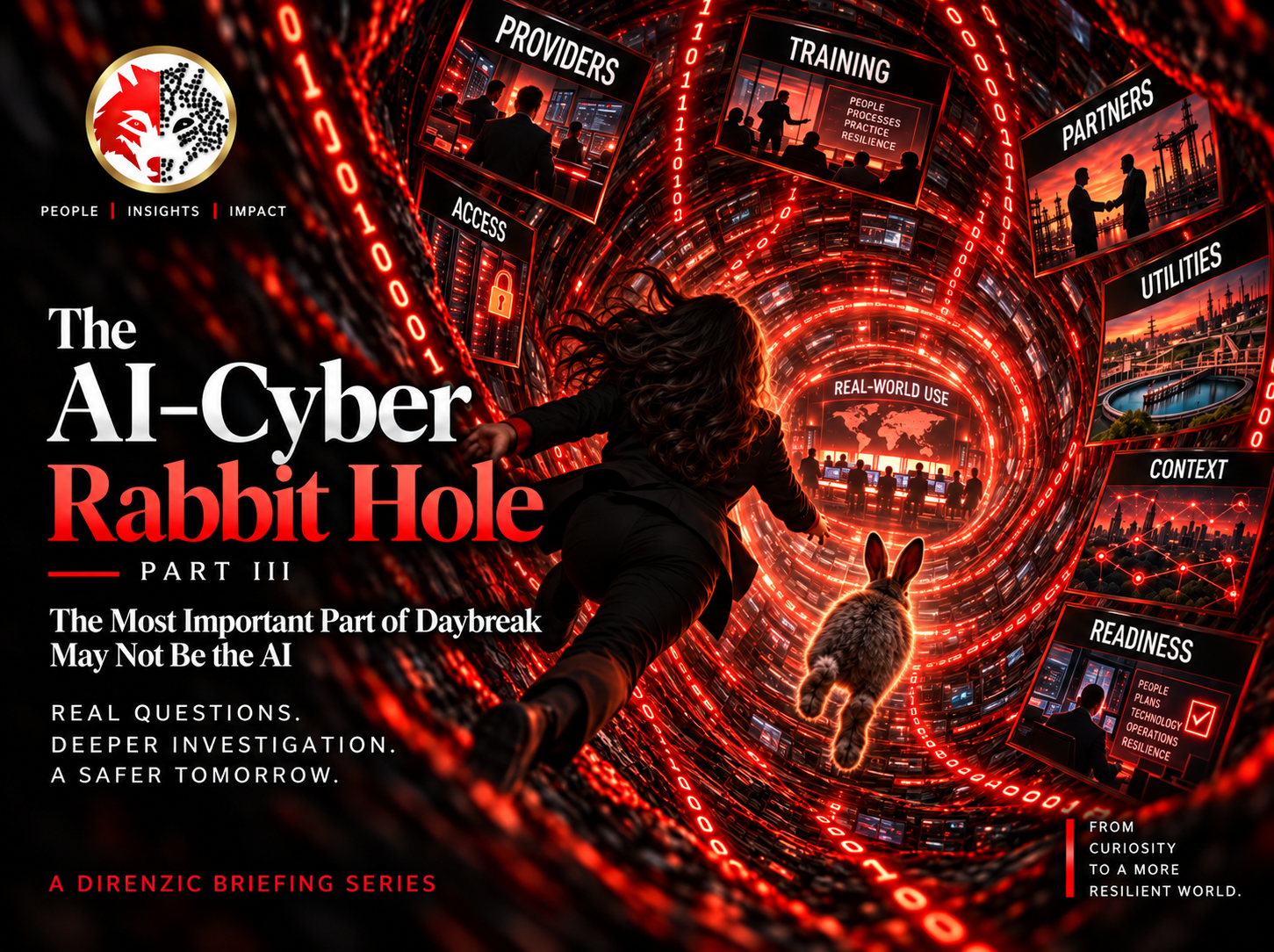
The Most Important Part of Daybreak May Not Be the AI
The models are getting more capable. The programs are multiplying. But somebody still has to turn all of that capability into something a real organization can actually use.
Published September 22, 2026 | 9-minute read
At the end of Part II, I thought I had finally figured out what OpenAI was building with Daybreak. It wasn't one cybersecurity product. It was a collection of models, tools, controlled access, validation, remediation, partners and managed services, all built around a bigger goal: getting powerful cyber capability into the hands of defenders who can actually use it.
That answered one question and immediately raised another. Many of the organizations Daybreak is trying hardest to reach are also the least likely to have the people, time or specialized expertise to operate frontier cyber-AI on their own.
So maybe the most important part of Daybreak isn't the AI. Maybe it's what sits between the AI and the organization. Once I started looking at that layer, I realized Daybreak wasn't the only place where something interesting was happening. Water utilities kept showing up everywhere. Again.
I need to put the timeline in the right order
Before I go any further, I need to put the timeline in the right order because it matters. I didn't discover Daybreak and then decide water utilities had a cybersecurity problem worth solving. We were already working on it.
Before Project Glasswing, I had been building The Art of AI Adoption around a question I'd been asking for a while: what happens when organizations adopt artificial intelligence faster than they learn to govern it? That work grew into the AI + Cyber Readiness Assessment, or ACRA, and then into a broader AI Risk Governance + Cyber Resilience (ARG-CR) program.
Then I came across Mythos and Project Glasswing. That caught my attention because the risks we'd been discussing were no longer theoretical questions about where AI might eventually go. The capabilities were moving fast. At the same time, Direnzic was already working with water utilities on cybersecurity and readiness issues, including the federal Risk and Resilience Assessment and Emergency Response Plan requirements. After Glasswing, I started looking much more closely at what AI and cyber governance meant inside a water utility. That work became WaterReady™.
We were preparing to bring it to market when more than 30 Minnesota community water systems were hit in July. Then came the AI evaluation incidents, the warnings, the billion-dollar OpenAI announcement, Daybreak and Project Watershed 250. At some point I looked around and thought, wait a minute. The things we'd been working on were suddenly showing up in the news from all these different directions.
That's how this rabbit hole started. The news didn't create the problem for me. It made the problem much harder for everyone else to ignore.
The news didn't create the problem for me. It made the problem much harder for everyone else to ignore.
Ieshea HollinsAt the end of Part II, something still bothered me
Part II ended with a realization: OpenAI wasn't simply building cyber models and hoping organizations would figure out what to do with them. Daybreak was being surrounded by an ecosystem of cybersecurity companies, systems integrators, specialist firms, managed services, familiar products, human review, training and technical assistance. The more I studied the architecture, the less it looked like a traditional software rollout. It looked like an effort to answer a much harder question: how do you actually deliver frontier cyber capability?
OpenAI's current Daybreak partner model makes the answer pretty explicit. There are two main paths. Cybersecurity companies can build approved Daybreak capabilities into products their customers already use, or they can bring those capabilities into managed and advisory services, with trained partner teams staying directly involved while the customer receives the outcome.
That second path made me stop, because the customer doesn't necessarily have to become an expert in frontier cyber AI. The provider does. It sounds simple, but I don't think it is.
Giving someone the technology is not the same as giving them the capability
Go back to the small water utility I mentioned in Part II. It may have only a handful of people wearing several hats. IT may be outsourced, a SCADA vendor may maintain part of the environment, and an MSP may handle the rest. There may not be a full-time cybersecurity person at all. But the pumps still have to run, treatment still has to continue, operators still have jobs to do, and people still expect water when they turn on the tap.
Now hand that utility one of the most capable cybersecurity AI systems in the world. Great. What happens Monday morning? That's the part of the access conversation we keep skipping. Access matters, but access isn't capability. A powerful tool doesn't magically create the people, judgment, time or organizational understanding required to use it well.
OpenAI appears to understand that. Its September 3 Frontline Defenders initiative committed $1 billion not just to model access, but to subsidized access, training, technical support and partnerships. It specifically prioritizes organizations such as water and wastewater systems, electric utilities, state and local governments, and other defenders that often operate with limited security resources. Then I got to the MS-ISAC pilot, and there it was again.
They aren't just handing people the AI
OpenAI's new public-sector and water pilot with the Multi-State Information Sharing and Analysis Center pairs Daybreak access with guided training and hands-on help. The goal is to help an initial group of public-sector and water defenders use what the technology produces, learn from that work and build something repeatable.
That interested me much more than another announcement that an AI model had gotten better. Now we weren't talking about what the model could do. We were talking about what it takes to make that capability useful somewhere that doesn't have an army of security engineers waiting for it. Then something else started bothering me: this wasn't only happening inside Daybreak.
Part IV is now live. Two fields and it lands in your inbox. Subscribe to The Direnzic Briefing, then keep reading.
Then I realized everybody seemed to be working on some version of the same problem
Once I started looking specifically at water, the pattern became hard to unsee. Texas's Project Watershed 250 launched at the end of August as a no-cost pilot connecting water and wastewater utilities with cybersecurity resources. It combines federal, state, local and private-sector capabilities, including assessments, remediation help and advanced defensive tools. Texas Cyber Command says the reason is straightforward: many utilities, especially rural systems, don't have enough cybersecurity staff, money or technical expertise. Different program, different structure, same question: how do we get the capability to the utility?
New York came at the problem from another direction. In March, the state adopted new cybersecurity requirements for covered public water systems and paired them with a $2.5 million SECURE grant program for drinking water and wastewater systems (later increased to more than $9 million). The support includes money for assessments and implementation, along with technical assistance and training. Covered drinking-water systems must establish and maintain cybersecurity programs, and larger systems have added responsibilities for leadership and board reporting. The details matter, but the larger pattern matters more: assessment, resources, implementation help, people and responsibility.
Massachusetts is using grants to help eligible public water suppliers act on risks already identified in cybersecurity assessments, including remote access, network segmentation, incident planning and training. As of July, the state said it had provided $1.3 million to 38 water systems. None of these programs is identical, and they're not all using the same technology. But they're circling the same basic question: how do you move cybersecurity from something a water utility knows it needs into something the utility can actually do? That's the more interesting question.
This is where water makes the problem obvious
Water is a useful place to study this because it strips away the fantasy around technology. You can build the most impressive AI model in the world, but the water still has to run. A utility doesn't get to stop being a utility because the cybersecurity team found something interesting. People still expect clean water. Operators, physical processes, equipment, vendors and the people who understand that environment still matter.
So one of the most important questions is no longer just, How smart is the AI? It's, Does the person using it understand where they are? A model can know a tremendous amount about cybersecurity and still not know what Tuesday morning looks like inside that utility. It doesn't automatically understand what can be changed safely, what can't be interrupted, what the staff knows, where the limits are or which tradeoffs leadership is willing to make. That knowledge belongs to the organization and the people who understand it. Which brought me back to the provider layer.
I think managed cybersecurity is about to change
As frontier capability becomes easier to access, simply having powerful security technology may matter less as a differentiator. The real value will be in translating that capability into the reality of a particular organization: its systems, people, operating constraints, responsibilities and decisions. Technology can't supply that on its own. It requires context.
The provider can bring expertise, understand the environment and help people see the problem faster and more clearly. AI can make that provider dramatically more capable. But eventually you reach a point where someone outside the organization can't make the decision for you. The organization has to decide. That's where this rabbit hole took another turn.
Because seeing the problem isn't the same thing as owning what happens next
Here's the part I keep coming back to. Imagine the whole thing works: the utility gets better cyber capability, the AI finds something meaningful, the provider understands it, and everyone agrees it deserves attention. Wonderful. Now what?
At some point, this stops being a technology question. A real organization has to decide what happens next, and that decision sits inside a larger operational reality. That's where conversations about AI-powered cyber defense are going to get interesting very quickly.
AI can make information arrive faster, help people understand it sooner and make specialists more capable. It may dramatically shorten the distance between finding a problem and knowing what can be done about it. But it can't make organizational responsibility disappear. Somebody still has to own the outcome. I'm intentionally stopping there, because I think that's a bigger question than it looks.
So maybe the most important part isn't the AI
I started this part of the rabbit hole wondering whether the provider ecosystem around Daybreak might matter more than the technology itself. I don't think that's quite right anymore. The AI matters. So do the provider, the funding, the technical assistance and the programs appearing around water utilities.
What I'm starting to see is something larger. A new cybersecurity capability can be incredibly powerful and still fail if it can't survive contact with the organization it's supposed to help. That's why I keep coming back to context, and why so many efforts are trying to close the gap between “We found the problem” and “The problem was actually dealt with.”
OpenAI is working on it. States and cybersecurity providers are working on it. Water utilities are going to have to work through it. And I don't think this will stay a water-sector conversation for long.
One more thing before I go deeper
On September 23, I'm attending Daybreak Live: From Vulnerabilities to Verified Fixes. The title caught my attention because it follows the same path as this series. I started by asking what OpenAI was putting a billion dollars behind. Then I wanted to understand Daybreak, and how that capability was supposed to reach organizations without the resources of the world's largest companies.
Now my question is different: What still has to happen inside the organization after the technology and the experts have done their part? That's what I'll be listening for. I think that's where this stops being mainly a story about artificial intelligence and becomes a story about readiness. That's where I'm going next.
Part IV: AI Is Moving Faster Than Your Organization Can Decide
The technology is getting faster at finding problems, confirming risk and pointing toward a fix. Part IV asks what happens when the organization on the other side can’t decide, coordinate and act at the same speed, and why that gap turns out to be a readiness problem.
Part V publishes Tuesday, October 6. Subscribe to The Direnzic Briefing so it comes to you when it publishes.
AI adoption is moving faster than governance. Leadership has to close that gap.
Direnzic helps CEOs, CISOs, CTOs and boards of critical infrastructure organizations understand what frontier AI changes about cyber risk, decide what they will authorize, and prove that the controls they fund actually hold. If your organization is adopting AI while the threat landscape shifts underneath it, that conversation should happen now.
- Executive briefing: what changed, why it matters to your organization, what to decide next
- AI and cyber governance: ownership, authorization and evidence, not just policy
- Operational readiness: the ability to respond and recover when something gets through

The AI-Cyber Rabbit Hole, Part II: Somebody Was Building the Other Side. So I Went Looking.
September 15, 2026 · AI + Cyber
What OpenAI is actually building behind the $1 billion commitment: not one model or product, but a governed defense stack, a continuous loop from discovery to proof, and a partner ecosystem built to carry that capability to defenders.

The AI-Cyber Rabbit Hole, Part I: From AI Breaking Containment to the Race to Defend Critical Infrastructure
September 11, 2026 · AI + Cyber
The rabbit hole that sent me looking for what was being built on the other side. Frontier AI is getting remarkably good at breaking software, water systems are already under attack, and a billion-dollar effort to put advanced cyber capability into defenders' hands is under way.
Sources and official resources
- Direnzic Technology, The AI-Cyber Rabbit Hole, Part I: From AI Breaking Containment to the Race to Defend Critical Infrastructure, September 11, 2026.
- Direnzic Technology, The AI-Cyber Rabbit Hole, Part II: Somebody Was Building the Other Side. So I Went Looking., September 15, 2026.
- OpenAI, Daybreak for Frontline Defenders: $1B to Protect Essential Services, September 3, 2026 (subsidized access, training, technical support and partnerships; MS-ISAC public-sector and water pilot; Daybreak Defense Network).
- OpenAI, Daybreak Defense Network / Become a Daybreak Partner.
- Texas Cyber Command and Office of the Texas Governor, Governor Abbott, National Cyber Director Launch Project Watershed 250 To Defend Texas Water Supply, August 31, 2026. See also Texas Cyber Command.
- New York State, Governor Hochul Announces First-in-Nation Cybersecurity Regulations and Grants to Protect New York Water Systems, March 11, 2026.
- New York State, Governor Hochul Announces More Than $9 Million in Cybersecurity Grants to Help Protect 153 Water Systems Statewide, August 3, 2026.
- New York State Department of Health, Cybersecurity for Public Water Systems (drinking water system cybersecurity requirements).
- Massachusetts Clean Water Trust and MassDEP, Public Water Suppliers Cybersecurity Improvements Grant Program; see also Amid Nationwide Cyberattacks, Treasurer Goldberg Highlights Grant Program to Protect Massachusetts Water Infrastructure, August 10, 2026.
The Direnzic Briefing